Third‑Party Motor Insurance: Laws, Myths & Common Mistakes
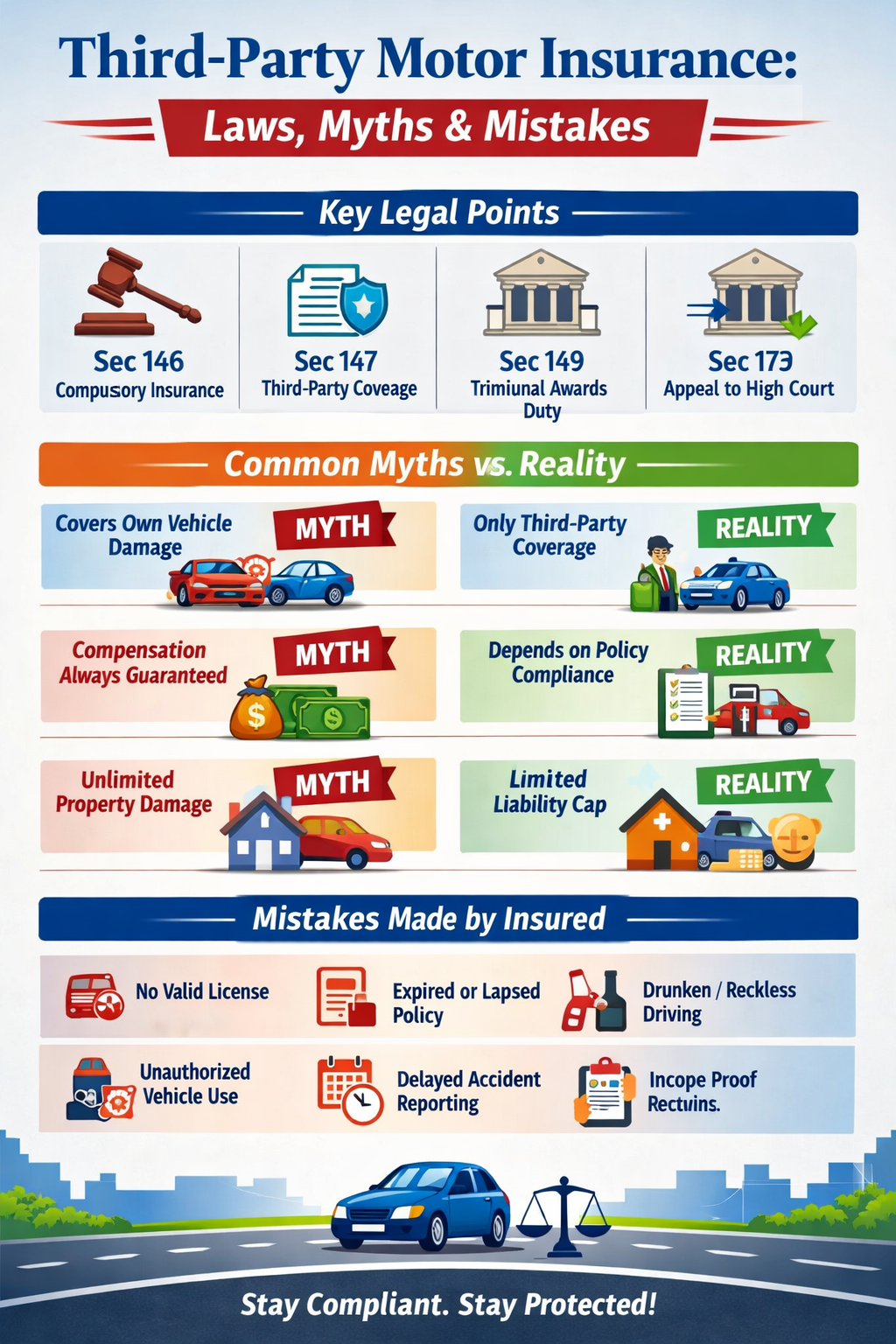
Learn about third‑party motor insurance laws in India, common myths, and mistakes insured individuals make that lead to claim rejection. Stay compliant to protect your rights and secure fair compensation.
⚖️ Legal Framework of Third‑Party Insurance
- Mandatory Requirement: Section 146 of the Motor Vehicles Act, 1988 makes it compulsory for all vehicles to have third‑party insurance before being driven on public roads.
- Scope of Coverage:
- Injury or death of a third party (pedestrians, passengers, other drivers).
- Damage to third‑party property caused by the insured vehicle.
- Compensation is determined by Motor Accident Claims Tribunals (MACT).
- Exclusions:
- Damage to the insured’s own vehicle.
- Injuries to the insured driver (unless personal accident cover is added).
- Accidents occurring due to policy violations (e.g., drunken driving, invalid license).
- Judicial Interpretation: Courts have consistently upheld the mandatory nature of third‑party insurance to ensure victims are not left without remedy.
📌 Key Provisions Under the Motor Vehicles Act
| Section | Provision | Impact |
|---|---|---|
| 146 | Compulsory insurance for all vehicles | Driving without insurance is punishable. |
| 147 | Requirements of policies and limits of liability | Defines minimum coverage for third‑party risks. |
| 149 | Duty of insurers to satisfy judgments | Insurers must pay compensation awarded by tribunals, subject to policy conditions. |
| 173 | Appeals | Orders of MACT can be appealed in High Courts within 90 days. |
🚫 Common Mistakes by Insured Leading to Claim Rejection
- Driving without a valid license.
- Using a private vehicle for commercial purposes.
- Drunken or reckless driving.
- Failure to renew policy before expiry.
- Suppression of facts or false accident reporting.
🔑 Practical Takeaways
- Always renew your policy on time to avoid lapses.
- Carry valid documents (license, registration, insurance certificate).
- Avoid policy breaches like unauthorized vehicle use.
- Report accidents promptly to police and insurer.
Third‑party motor insurance is the backbone of India’s road safety and compensation system. It ensures victims of accidents receive timely relief, while protecting insured individuals from heavy financial liability. By complying with the Motor Vehicles Act and avoiding common mistakes, vehicle owners can safeguard their rights and prevent claim rejections.
Here are some of the landmark judgments on third‑party motor insurance in India that shaped how claims are handled under the Motor Vehicles Act, 1988:
⚖️ Landmark Judgments on Third‑Party Insurance
- Minu B. Mehta v. Balkrishna Nayan (1977) The Supreme Court held that negligence must be proven before compensation can be awarded under Section 166. This case clarified the foundation of liability in motor accident claims.
- United India Insurance Co. Ltd. v. Lehru (2003) The Court ruled that insurers are not liable if the driver did not hold a valid license. Entrusting a vehicle to an unlicensed driver is a breach of policy conditions.
- National Insurance Co. Ltd. v. Swaran Singh (2004) A landmark case where the Supreme Court explained that insurers can avoid liability if there is a fundamental breach of policy conditions, such as driving without a valid license. However, insurers must still pay third‑party victims and then recover the amount from the insured.
- Oriental Insurance Co. Ltd. v. Brij Mohan (2007) The Court rejected a claim because the insured used a private vehicle for commercial purposes, violating the terms of the insurance policy.
- National Insurance Co. Ltd. v. Pranay Sethi (2017) While this case expanded the scope of compensation by including future prospects in income calculation, it reaffirmed that claims must comply with statutory and policy conditions.
📌 Key Takeaways
- Third‑party insurance is mandatory under Section 146 of the Motor Vehicles Act.
- Courts consistently uphold insurers’ right to deny claims when insured parties breach fundamental conditions.
- Victims are protected, but insured individuals must comply with policy terms to avoid losing claims.
- Limited Coverage
- Third‑party insurance only covers injury, death, or property damage to third parties.
- It does not cover damage to the insured’s own vehicle or personal injuries (unless personal accident cover is added).
- Policy Breaches by Insured
- Driving without a valid license, drunken driving, or using the vehicle for unauthorized purposes (e.g., commercial use when insured for private use) can lead to claim rejection.
- Courts have upheld insurers’ right to deny claims in such cases (Lehru, Swaran Singh, Brij Mohan).
- Delayed Reporting
- If the accident is not reported promptly to police or insurer, claims may be weakened or denied.
- Insurer’s Right to Recover
- Even if insurers pay compensation to third‑party victims, they can later recover the amount from the insured if there was a breach of policy conditions (Swaran Singh, 2004).
- Cap on Property Damage
- Compensation for third‑party property damage is capped under Section 147 of the Motor Vehicles Act, which may not cover actual losses.
- Exclusions Hidden in Fine Print
- Many policies exclude liability for passengers not covered, unauthorized drivers, or accidents outside India.
- Insured individuals often overlook these clauses.
Third‑party motor insurance is mandatory under the Motor Vehicles Act, 1988, but it has loopholes that can leave insured individuals vulnerable. Limited coverage, strict policy conditions, and insurer recovery rights mean that even minor lapses — like driving without a valid license or using a vehicle beyond its insured purpose — can result in loss of compensation. Landmark judgments such as Swaran Singh and Lehru highlight these pitfalls.
💼 Income Proof Mistakes in Motor Accident Cases
When filing a claim for compensation, proving the victim’s income is crucial. Courts and tribunals rely on documented evidence to calculate loss of dependency and award fair compensation. Many claims fail or are undervalued because of mistakes in presenting income proof.
❌ Common Income Proof Mistakes
- No Documentary Evidence Claimants often fail to submit salary slips, employment certificates, or business records. Without proof, tribunals may assume a lower notional income.
- Unreliable or Fake Documents Submitting forged or inconsistent records can lead to outright rejection of claims.
- Failure to Produce Employer Testimony Not calling the employer or accountant as a witness weakens the credibility of income claims.
- Ignoring Tax Records Income tax returns are strong evidence. Failure to produce them often results in reduced compensation.
- Overstating Income Inflated claims without supporting documents are usually dismissed by courts.
⚖️ Landmark Judgments on Income Proof
- Sarla Verma v. Delhi Transport Corporation (2009) The Supreme Court standardized the multiplier method and emphasized the need for reliable income proof.
- National Insurance Co. Ltd. v. Pranay Sethi (2017) Clarified that future prospects must be added to proven income, but only when credible evidence is produced.
- Reshma Kumari v. Madan Mohan (2013) Reaffirmed that compensation must be based on documented income, not speculative figures.
Third‑party insurance is mandatory under the Motor Vehicles Act, 1988, but many people misunderstand what it actually covers. These myths often lead to false expectations and rejected claims.
❌ Common Myths vs. Reality
- Myth 1: Third‑party insurance covers my own vehicle damage. Reality: It only covers injury, death, or property damage to third parties. Your own vehicle damage is not covered unless you have a comprehensive policy.
- Myth 2: Compensation is guaranteed regardless of circumstances. Reality: Compensation depends on compliance with policy conditions. Driving without a valid license, drunken driving, or unauthorized vehicle use can lead to claim rejection.
- Myth 3: Third‑party insurance covers unlimited property damage. Reality: Property damage compensation is capped under Section 147 of the Motor Vehicles Act. Actual losses may exceed the statutory limit.
- Myth 4: Insurers cannot deny claims. Reality: Insurers must pay third‑party victims, but they can later recover the amount from the insured if there was a breach of policy conditions (Swaran Singh, 2004).
- Myth 5: Third‑party insurance covers passengers in all cases. Reality: Coverage depends on the type of policy and whether passengers are legally permitted. Unauthorized passengers may not be covered.
Limitations and conditions. Believing myths like “it covers my own vehicle” or “claims can never be denied” often leads to disappointment. Landmark judgments such as Swaran Singh and Lehru highlight that compliance with policy terms is critical. Vehicle owners should understand these realities to avoid loss of compensation and ensure proper protection.
🚗 Third‑party motor insurance is mandatory under the Motor Vehicles Act, 1988. It protects accident victims by ensuring compensation for injury, death, or property damage caused by the insured vehicle. Yet, many insured individuals lose claims due to misunderstandings and mistakes. This blog explains the legal framework, debunks common myths, and highlights mistakes insured persons often make.
